
Guides & Materials
Cabinet Refacing vs. Replacing: What Actually Makes Sense for Your Kootenay Kitchen
August 12, 2026 · Steinegg Cabinets, Nelson BC
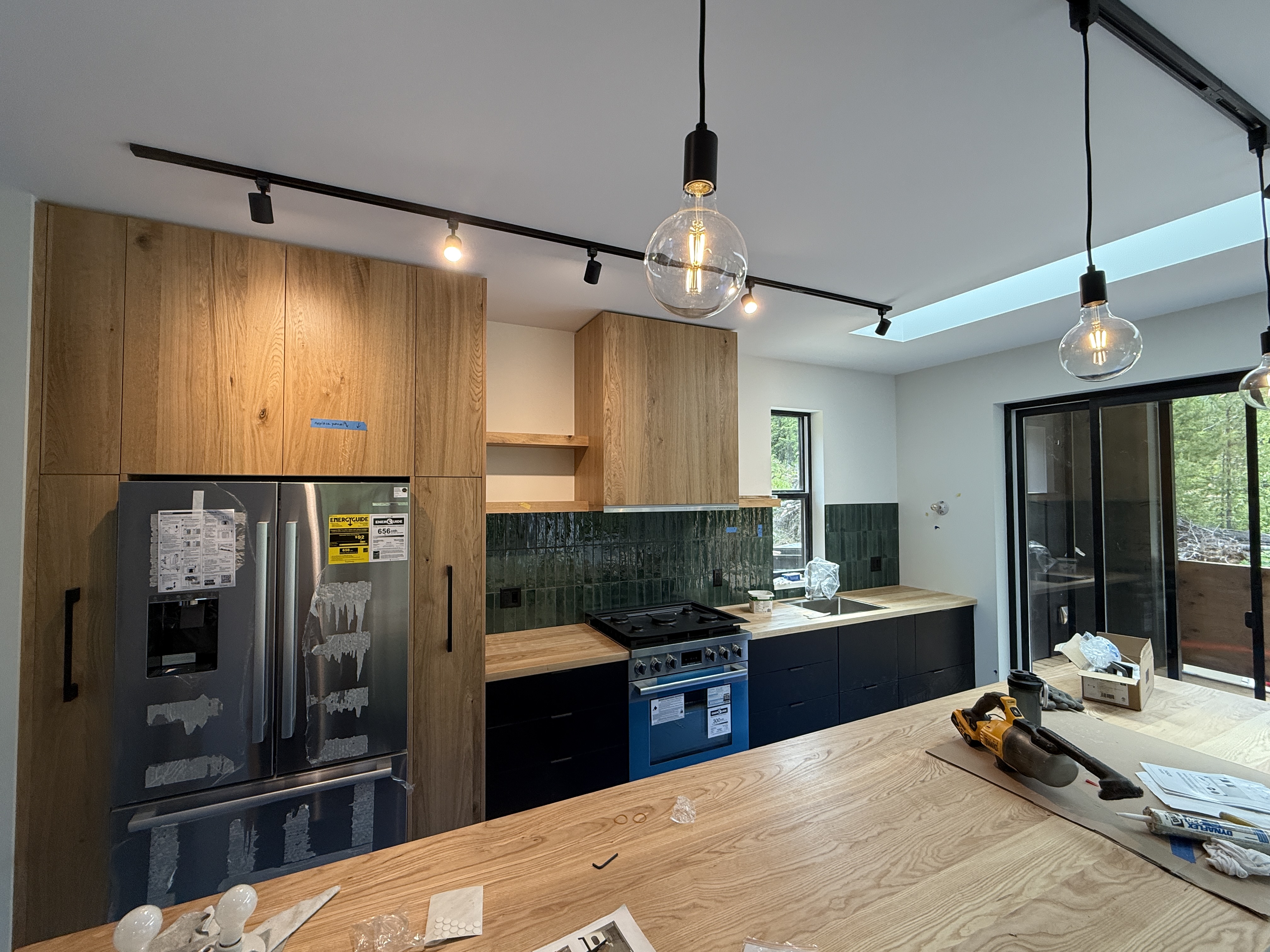
Cabinet Refacing vs. Replacing: What Actually Makes Sense for Your Kootenay Kitchen
If your cabinets are starting to look tired but the layout still works fine, someone has probably told you "just reface them, it's way cheaper." That's sometimes true. It's also the kind of advice that gets handed out without anyone looking at your actual boxes first, and in our shop that's the part that decides everything.
Refacing and replacing solve different problems. Mixing them up wastes money either way — spending replacement money on a kitchen that only needed a facelift, or spending on a facelift that was never going to hold up on a bad foundation.
What refacing actually is
Refacing means keeping your existing cabinet boxes — the carcasses bolted to your walls — and changing everything you see and touch: new doors, new drawer fronts, new hinges and slides, and a matching veneer or laminate skin over any exposed box surfaces (end panels, the front face frame). The inside of the box stays exactly what it was.
What we tell clients considering this route: refacing is only as good as the box underneath it. If your boxes are square, dry, and structurally sound, a reface can genuinely look like a new kitchen for a fraction of the cost. We're talking roughly $4,000–$12,000 for an average Kootenay kitchen versus $15,000–$35,000+ for a full replacement with comparable materials, though both ranges swing hard depending on size, door style, and whether you're touching the layout at all.
If your boxes have water damage under the sink, particleboard that's swollen or delaminating, or a layout you've hated for a decade — refacing won't fix any of that. New skin on a soft box just delays the same problem.
What replacement actually is
Full replacement means new boxes from scratch, which opens up things refacing can't touch: moving the sink, widening a doorway, adding a pantry tower where a dead corner used to be, switching from particleboard to plywood construction, changing box depth for a different countertop overhang. It's more disruptive — expect your kitchen out of commission for one to three weeks depending on scope, versus a few days for a reface — and it costs more because you're paying for materials and labour twice: demo of the old, build of the new.
We wrote a longer breakdown of box construction itself in our piece on melamine particleboard vs. birch plywood cabinet boxes if you want to go deeper on what's actually inside a box before you decide whether it's worth keeping.
The question that actually decides it
Before cost, before style, ask this: are the boxes worth keeping? That's a hands-and-knees question, not a from-across-the-room one. Open every door, pull every drawer, check the toe kick and under the sink for water staining, press on the particleboard bottoms to feel for softness, and check that the boxes are still square — cabinets that have racked out of square from years of a floor settling won't take new doors cleanly no matter how good the reface work is.
Up here, that check matters more than in a lot of places. Kootenay homes run wood stoves and swing hard between bone-dry winter heat and humid shoulder seasons, and older particleboard boxes — especially ones installed before better moisture-resistant cores were standard — show their age faster than solid wood or plywood ones do. We've opened up 20-year-old kitchens where the boxes were fine and 12-year-old ones where they weren't, so age alone isn't the tell. The wood is.
Layout is the other half of the decision
Refacing is layout-neutral by definition — same footprint, same box locations, same everything except finishes. If you're happy with where the fridge, sink, and stove are and just want the kitchen to stop looking dated, that's a point in favour of refacing regardless of box condition (assuming the boxes pass the check above).
If you've been working around a bad layout — not enough counter space next to the stove, a fridge that blocks the main walkway, no pantry — refacing keeps that problem forever. That's when it's worth talking through a full redesign. Our Reimagine process exists for exactly that: figuring out what a kitchen could be before committing to what it costs to get there.
Cost isn't just cabinets
Whichever way you go, don't forget the domino costs. Replacement often means new countertops (different box dimensions rarely fit old counters), sometimes new flooring where old cabinets covered a gap, and occasionally electrical or plumbing moves if you're relocating anything. Refacing is much more contained — countertops and floors usually stay put — which is a big part of why the total gap between the two options is often wider than the cabinet quote alone suggests.
If countertops are part of your decision either way, our comparison of laminate, quartz, and granite walks through what each actually costs and how they hold up here.
Our honest take
We build both new cabinets and, less often, reface existing ones, so we don't have a side to push. If your boxes check out and your layout works, refacing is a legitimately smart way to get a new-looking kitchen without a new-kitchen bill. If either of those isn't true, refacing is a way to spend real money on a kitchen that still won't work right. The only way to know which situation you're in is to have someone actually look at the boxes — not guess from a photo or a phone call.
If you want that look, get in touch and we'll tell you straight which side of the line your kitchen is on.
FAQ
Can you reface cabinets that were originally built by another shop? Yes, in most cases. What matters is the condition and squareness of the existing boxes, not who built them. We do ask to see them in person or via clear photos before quoting.
Does refacing let me change my door style completely — like from oak raised-panel to a flat modern slab? Yes, that's one of the main appeals. The new doors and drawer fronts are built fresh in whatever style, wood, or finish you want; only the box behind them stays the same.
How long does a typical refacing project take from order to install? Doors and fronts are custom-built, so expect several weeks of lead time for fabrication, then usually 2–4 days on-site for installation, similar to a lot of custom shop timelines in our area.
Is refacing worth it if I'm planning to sell in a couple of years? Often yes — refacing gets you most of the visual impact of a new kitchen at a lower cost, which tends to be the right math for resale timelines. A full gut is harder to justify unless the layout is genuinely a problem for buyers.
What if I only find out the boxes are bad after I've committed to refacing? That's exactly why we check first. A reputable shop won't sell you new doors for boxes that won't hold them — if we find damage during our walkthrough, we'll tell you before any doors get ordered, not after.
Planning a project in the Kootenays?
Talk it through with a local shop — free consultation, honest advice, built-to-fit cabinetry from Nelson, BC.