
Guides & Materials
Laminate, Solid Surface, Quartz, or Granite: Which Countertop Actually Makes Sense for Your Kootenay Kitchen?
July 21, 2026 · Steinegg Cabinets, Nelson BC
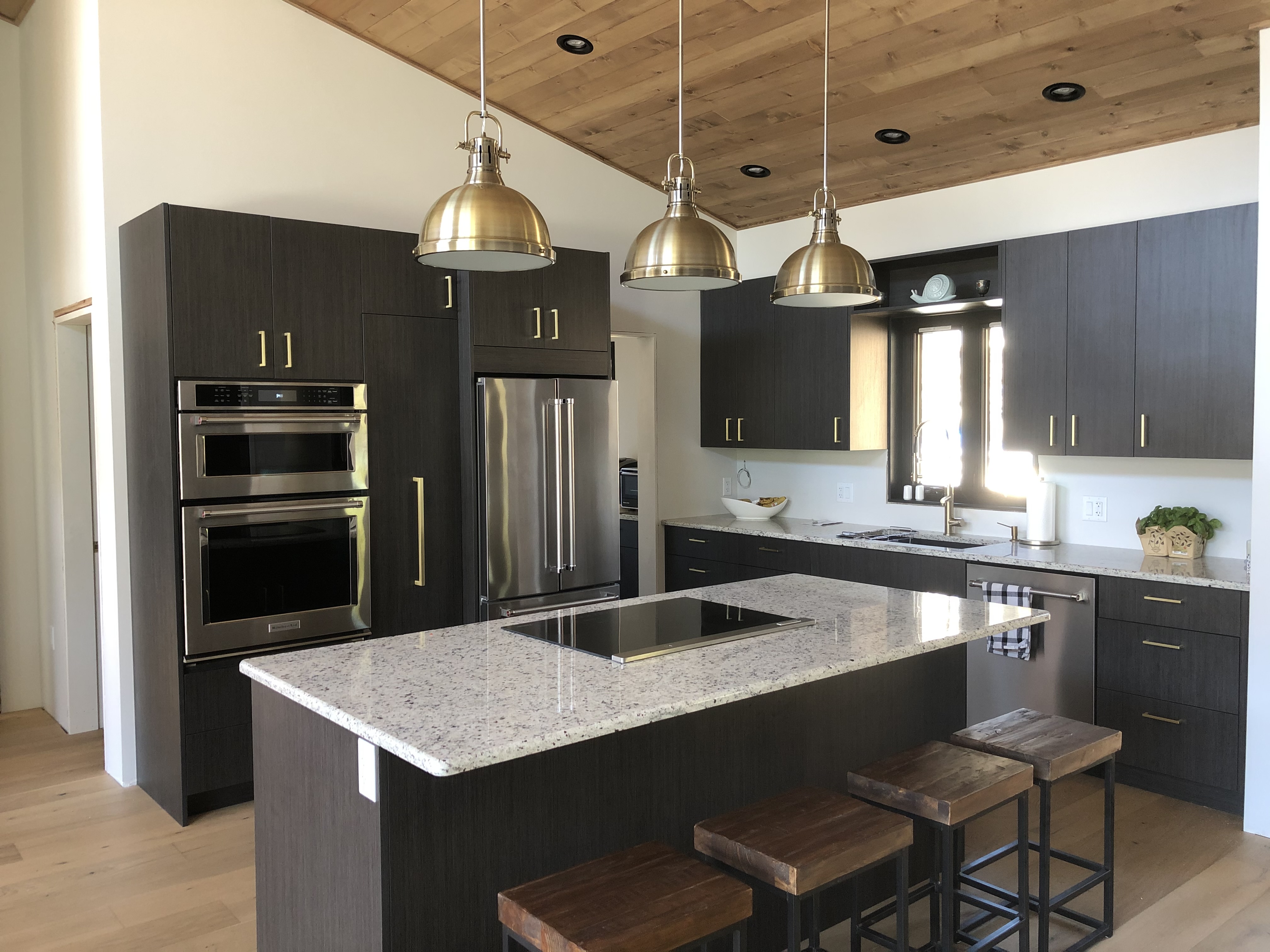
Laminate, Solid Surface, Quartz, or Granite: Which Countertop Actually Makes Sense for Your Kootenay Kitchen?
Short answer: for most kitchens we quote in the West Kootenay, quartz is the material that gives you the fewest regrets — it doesn't need sealing, it shrugs off the humidity swings you get between a damp spring and a bone-dry woodstove winter, and it holds resale value. But it's not automatically the right call. If you're renovating a rental, doing a cabin, or working with a tight budget, laminate is still a completely reasonable material, and if you want a genuinely seamless integrated sink, solid surface does something the others can't. Granite has a smaller niche than it used to, but it's not gone. And butcher block comes up in nearly every conversation, usually for the wrong reason. Here's how we actually walk clients through the decision in our shop.
The materials, in plain terms
Laminate is a printed pattern layer bonded to a particleboard or MDF substrate. Modern laminate — think Formica, Wilsonart, Arborite — looks a lot better than the laminate your parents had, with convincing stone and matte finishes. It's the only one of these you can't have professionally repaired if it's badly damaged; a burn or a deep gouge means replacing that section.
Acrylic solid surface is a solid sheet of acrylic resin and minerals. Corian is the brand name most people know; the lines we actually fabricate are Meganite and Durasein, which are the same material category and, in our experience, every bit as good. The whole selling point is that seams can be glued and sanded until they disappear, so you can get an integrated sink and backsplash with zero visible joints. It scratches more easily than stone, but because it's solid all the way through, most scratches and burns can be sanded out instead of replaced.
Quartz is engineered stone — crushed quartz mixed with resin binders, pressed into slabs. It's non-porous out of the box, so no sealing, ever. It resists stains and scratches better than granite in daily use, but it's not heatproof — a hot pan straight off the stove can crack the resin or leave a discoloured ring, so trivets matter regardless of what the sales rep tells you.
Granite is a natural quarried stone, cut into slabs, polished, and sealed on installation. Every slab is genuinely one-of-a-kind, which some people love and some find stressful when they're trying to match a sample to what shows up on install day. It handles direct heat better than anything else here. It's porous, though, so it needs periodic resealing — how often depends on the specific stone and how dark it is.
Butcher block is solid wood, edge- or end-glued into a slab. We get asked about it constantly, and almost always because someone assumes it's the budget option. It isn't — properly made and installed, it lands in the same territory as quartz. We'll build it if you want it, but we'll tell you honestly that we're not enthusiastic, and the next section explains why.
What it actually costs installed
These are ranges, not quotes — fabrication, edge profile, and layout move the number a lot, and anything we tell you here should be confirmed against a real template of your kitchen. Per square foot, installed:
- Laminate: $40–$70
- Acrylic solid surface: $85–$130
- Butcher block: $130–$170
- Quartz: $130–$160
- Granite: $140–$200
The gap that surprises people most is butcher block. The assumption is that wood is the cheap option, and it simply isn't — it costs about what quartz costs, and it asks more of you afterward.
Between quartz and granite, the categories overlap enough that the specific slab matters more than the material name. The real budget lever is usually the pattern you pick within a category, plus how much edge detail and seaming your layout needs — not the category itself.
Why we're lukewarm on butcher block
Wood and water are a bad long-term pairing, and a kitchen countertop is where that pairing is hardest to avoid. The area around the sink is the problem: every splash, every wet dish, every drip down the front of the cabinet. Sealed wood is fine right up until the seal wears at the one spot that gets wet daily, and then you're sanding and re-oiling, or living with a dark stain and a swollen seam.
It can be done well. It needs a homeowner who genuinely doesn't mind maintenance, and it's a much easier recommendation on an island or a coffee bar with no sink in it than on a main run. What we push back on is choosing it to save money, because at $130–$170 a square foot it doesn't.
What we make ourselves, and what we don't
Worth knowing, because it affects your schedule more than most people expect:
We fabricate solid surface in our own shop. Meganite and Durasein counters are cut, seamed, and finished here in Nelson by us. That means the shortest turnaround of any material we offer and, more importantly, control — if something needs adjusting on install day, we adjust it ourselves instead of booking a return visit through a third party.
Everything else is outsourced to a fabrication partner we've worked with for years and trust. Laminate, quartz, granite, and butcher block all go through them. They do good work, but their schedule isn't our schedule, so slab materials carry more lead time and less flexibility if something changes late.
If your project has a hard deadline, that difference is worth weighing alongside the material itself.
Where our climate actually matters
We build in a shop in Nelson, and most of what we install ends up somewhere in the West Kootenay — Castlegar, Trail, Rossland, Creston, Kaslo, Salmo. A few things about this region change the calculus:
- Humidity swings. Kootenay homes go from damp in spring runoff season to genuinely dry once the wood heat comes on in winter. Laminate and its particleboard substrate can telegraph moisture problems at sink cutouts and seams if the edge seal fails — not a dealbreaker, just a reason the perimeter seal matters more here than in a milder coastal climate. It's also the same reason we're cautious about butcher block. Quartz and sealed granite don't care either way.
- Wood heat and hot cookware. A lot of our clients cook a lot, and many have a woodstove or wood cookstove running through winter, which means pots and cast iron move around the kitchen more than in a typical suburban build. That pushes some clients toward granite specifically for the heat tolerance, even though quartz wins on almost everything else.
- Logistics. Slab material comes in on a truck from a supplier in the Lower Mainland or Alberta, and a broken or wrong slab means a real delay, not a quick reorder. We build extra lead time into any slab-material quote for exactly this reason, more so for jobs out toward Creston or Kaslo.
How we actually help clients decide
In our shop, the conversation usually comes down to three questions, not "which material is best":
- How long are you staying? If this is a forever kitchen, quartz or granite pay for themselves in not doing this again. If it's a flip, a rental, or you're renovating with a five-year horizon, laminate is not a compromise — it's the correct choice.
- Do you want an integrated sink? If yes, solid surface is really the only option that gives you a seamless sink-and-counter in one piece without a visible joint. Quartz and granite sinks are undermount at best, with a visible seam line.
- What actually happens on your counter? Households that put hot pans straight down, do a lot of canning, or have a wood cookstove lean us toward granite. Households more worried about staining from wine, turmeric, or berry picking season lean toward quartz.
We work with all of these materials and we don't have a favourite we're pushing. The honest truth is that the "wrong" choice for a given household usually shows up in the first six months as a nagging irritation — a burn mark, a stain that won't lift, buyer's remorse on a bold slab pattern — rather than a structural failure. That's the thing worth spending your decision-making time on, more than chasing the theoretically toughest material on paper.
What we tell clients to skip worrying about
- "Quartz can't handle any heat at all." True in the sense that you shouldn't set a pot straight off the burner on it — but use a trivet regardless of material, full stop.
- Radioactivity concerns with granite. Some granites have trace radon emission, but it's well below any level Health Canada considers a residential concern for the vast majority of commercially sold slabs.
- "Laminate looks cheap." The current generation of laminate patterns, especially matte and textured finishes, reads as stone from a few feet away in a normal kitchen — most of that reputation comes from close-up photos under raking light.
If you're weighing countertop material against the cabinet boxes underneath it, it's worth reading our breakdown of melamine vs. plywood cabinet construction first — the two decisions interact more than people expect, especially around sink cutouts and moisture.
FAQ
Isn't butcher block the cheap option? No, and this is the single most common misconception we hear. Butcher block runs roughly $130–$170 per square foot installed, which puts it right alongside quartz. If budget is the driver, laminate is the honest answer.
Can I put a quartz countertop over existing cabinets? Usually yes, as long as the cabinet boxes are level and structurally sound — quartz is heavy enough that we check the box construction and support before templating, especially over older cabinets.
Do I need to reseal granite every year? Not necessarily — it depends on the stone. Lighter, more porous granites may need resealing annually; denser, darker stones can go several years. A simple water-drop test (does it bead or soak in?) tells you when it's due.
Is solid surface the same as quartz? No — this is one of the most common mixups. Solid surface (Corian, Meganite, Durasein) is acrylic resin all the way through; quartz is crushed stone in a resin binder. Solid surface scratches more easily but can be sanded and repaired; quartz resists scratches better but a chip usually means a professional patch or living with it.
Which countertop has the fastest turnaround? Solid surface, because we fabricate it ourselves in Nelson. Every other material goes through our outsourced fabrication partner, which adds lead time we don't control.
Can you install countertops on a renovation out in Creston or Kaslo? Yes — we regularly template and install throughout the West Kootenay. For slab materials especially, we build the travel and delivery timing into the schedule up front so there are no surprises. See our services page for how we handle site measures and install logistics outside Nelson, or get in touch to talk through your project.
If you're at the stage of picking materials for a full kitchen rebuild, our Reimagine process walks through cabinetry and countertop decisions together rather than in isolation, and our product gallery has examples of finished counters paired with different cabinet styles.
Planning a project in the Kootenays?
Talk it through with a local shop — free consultation, honest advice, built-to-fit cabinetry from Nelson, BC.