
Guides & Materials
Open Shelving in a Kootenay Kitchen: What It's Actually Like to Live With
October 15, 2026 · Steinegg Cabinets, Nelson BC
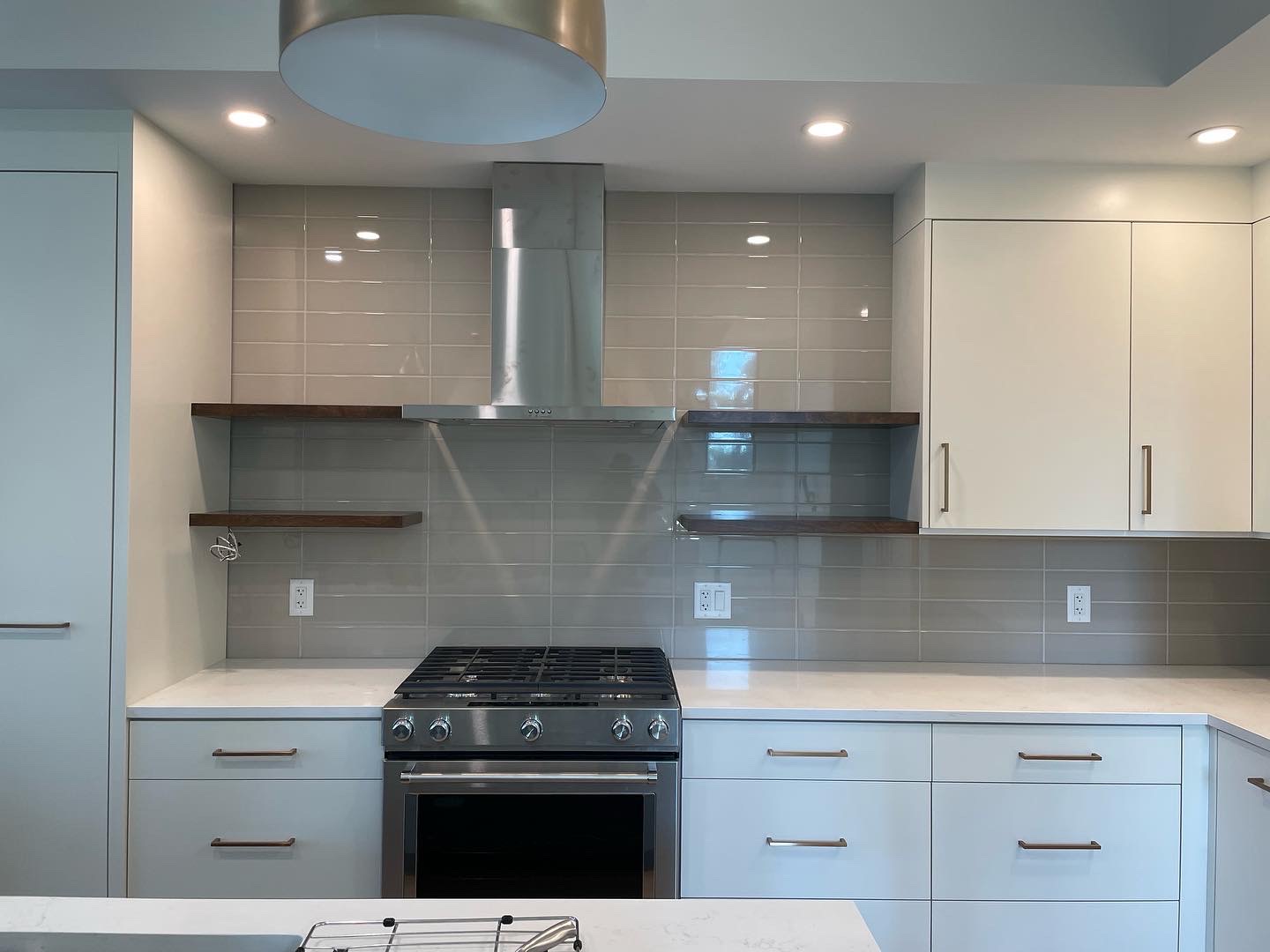
Open Shelving in a Kootenay Kitchen: What It's Actually Like to Live With
Open shelving looks great in photos. What nobody tells you is how it holds up next to a wood stove in February, or what happens to a solid walnut shelf when your house goes from 20% humidity in January to 55% in August. We get asked about open shelving almost every time we're doing a kitchen design in Nelson or anywhere up the Slocan or Kootenay Lake — usually because someone saw it on Pinterest or in a renovated heritage house in town. Here's the honest version, from a shop that builds both open shelving and upper cabinets and has no reason to push you toward either.
The appeal is real
Open shelves do three things well: they make a kitchen feel bigger, they put your stuff within arm's reach, and they're cheaper to build than a bank of upper cabinets with doors, hinges, and finished interiors. A floating walnut shelf and a couple of brackets is a fraction of the material and labour of a full cabinet box. If you're trying to stretch a renovation budget, swapping one run of uppers for open shelving is a legitimate way to save money — not just a style choice.
They also solve a real problem in older Kootenay homes: a lot of the housing stock here, especially the 1920s-40s miner's cottages and farmhouses around Nelson, Salmo, and up toward New Denver, has small, dark kitchens. Pulling the doors off (or just not building them) opens the room up visually in a way that's hard to fake otherwise.
What actually happens over a winter
This is the part people don't ask about until it's already a problem. Our winters are dry — a wood stove or a forced-air furnace running hard in January can pull indoor humidity down into the 20% range, sometimes lower in older homes without a lot of air sealing. Summers, especially if you run a humidifier for houseplants, swing the other way.
Wood moves with that. A solid wood shelf — walnut, oak, maple, whatever — will shrink across its width in the dry months and swell back in summer. On a floating shelf that's not confined on both ends, this usually just means a slightly looser or tighter fit where it meets the wall bracket, and maybe a small seasonal gap. It's rarely dramatic. Where we see actual cracking or cupping is with:
- Live-edge or figured wood (like walnut with character grain) that was not fully dried before milling
- Shelves cut from a single wide board rather than glued-up narrower strips, which move more unevenly
- Shelves installed tight against a wall on both ends with no room at all to expand
In our shop, when we're building a solid wood floating shelf for a Kootenay house, we spec kiln-dried stock, we glue up from narrower boards instead of using one wide slab where we can, and we use silicone to seal it. It's a small thing, but it's the difference between a shelf that ages fine and one that someone calls us about in March asking why there's a crack running through it.
If you're set on a single dramatic wide-plank shelf for the look, that's fine — just go in knowing some seasonal movement is part of the deal, not a defect.
We also highly suggest to use a engineered wood product to avoid big movements between seasons. The engineered wood products are structurally much more stable. This is exactly why we use engineered sheets so we don't have nearly as much movement with changing seasons.
The dust and grease problem is worse here, not better
Open shelving's biggest practical downside anywhere is dust and grease exposure. In a lot of homes that run a wood stove as primary or backup heat, there are more airborne particulate in the house over the winter than in a place heated purely by a sealed furnace. Combine that with a shelf six inches from a gas range, and you've signed up for wiping down plates and glassware before you use them, more often than the Pinterest photo suggests.
What we tell clients: open shelving works best for the stuff you actually use every week — the everyday bowls, the glasses, the cutting boards in rotation — not the good china that sits for six months between uses. If you want the open look but you cook a lot or run a wood stove, we'll often suggest open shelving on one wall away from the range, and closed upper cabinets flanking the hood where grease and heat are worst. That's exactly the kind of mixed layout you'll see in a lot of the kitchens we build now — a run or two of open shelving for display and daily-use items, real cabinets for the rest. Another option to make the room look more open is a glass door with light inside. This gives you protection from the dust and grease but you don't have to compromise the look. This is definitely a more expensive solution compared to an floating shelf.
Storage is the other trade-off
A standard 30-36" upper cabinet holds a surprising amount — second sets of dishes, the stand mixer attachments, the stuff you use twice a year. Pull that cabinet and replace it with two open shelves and you've lost most of that volume, because you can't stack an open shelf nearly as full as a cabinet without it looking like clutter. That storage has to go somewhere: a deeper pantry, more base cabinet drawers, or a butler's pantry if the floor plan allows it. We've had more than one client realize mid-design that losing three linear feet of uppers means finding that storage elsewhere in the kitchen, and it's much easier to plan for that up front than to retrofit it after the shelves are already up.
What we'd actually tell you to do
If you cook often, have small kids, or run a wood-burning stove as a heat source, lean toward mostly closed cabinets with maybe one accent run of open shelving somewhere low-traffic — over a buffet counter, beside a window, away from the cooktop. If you're more of a light cook, keep a tidy kitchen, and want the visual openness, a full open-shelf wall can genuinely work, especially with the clearances and wood selection handled right at the build stage.
Either way, material choice matters more here than in a milder, more humidity-stable coastal climate. That's worth reading about separately if you're deciding between solid wood and engineered cabinet materials for the rest of your kitchen, since the same humidity swings that affect a shelf affect cabinet boxes too.
FAQ
Will my open shelves crack in winter? Solid wood shelves can develop small seasonal gaps or, in worse cases, cracks if the stock wasn't properly dried or installed without room to move. Kiln-dried, glued-up stock with a little clearance at the wall handles our climate fine. Ask your builder specifically what they're using and how they're installing it.
Is open shelving actually cheaper than cabinets? Usually yes, on materials and labour — you're not paying for a box, doors, hinges, or finished interior. But if you lose storage you need elsewhere, that cost shows up somewhere else in the kitchen.
Can I mix open shelving and cabinets in the same kitchen? Yes, and it's often the best answer. Open shelving for everyday items away from heat and grease, closed cabinets around the range and for bulk storage.
What wood holds up best for open shelves in a dry climate? Any properly kiln-dried hardwood works — walnut, oak, maple are all common. The prep and installation matter more than the species: narrower glued-up boards and clearance for movement beat a single wide slab installed tight.
Do I need to seal or finish the shelf differently for humidity swings? A good finish on all sides (including the underside and ends, not just the top) slows moisture exchange and reduces how fast the wood reacts to swings. We finish all faces on anything we build, even the parts you won't see.
Thinking through a kitchen layout and want an honest read on where open shelving would and wouldn't work for how you actually cook? Get in touch or come see some options in our shop. You can also browse our cabinetry and millwork services or try sketching ideas with our Reimagine tool before we talk details.
Planning a project in the Kootenays?
Talk it through with a local shop — free consultation, honest advice, built-to-fit cabinetry from Nelson, BC.