
Guides & Materials
How to Clean Your Cabinet Doors Without Wrecking the Finish
October 29, 2026 · Steinegg Cabinets, Nelson BC
How to Clean Your Cabinet Doors Without Wrecking the Finish
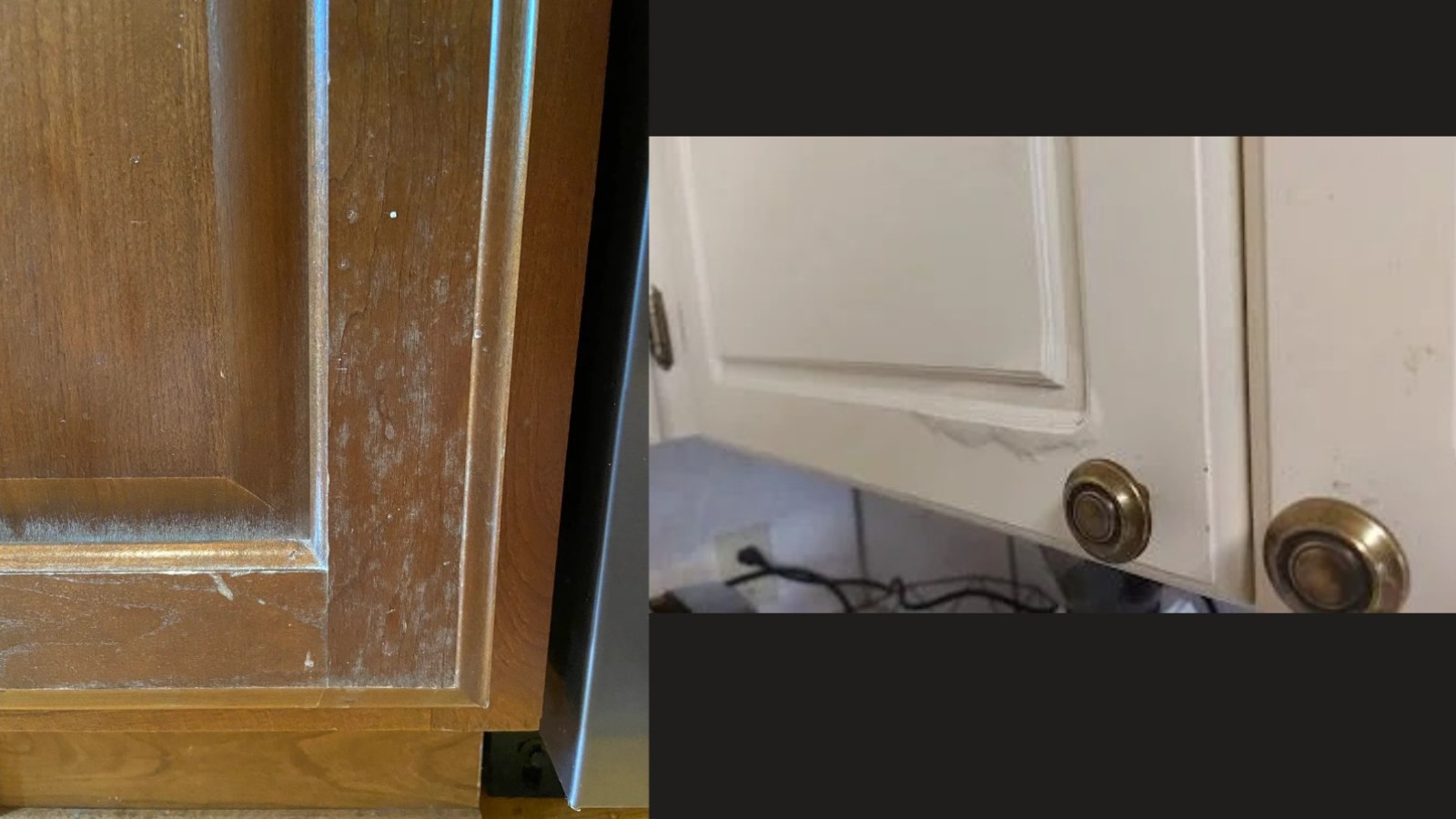
If you take one thing from this article: how you clean a cabinet door depends entirely on what it's made of, and the single biggest way we see finishes get wrecked early is someone using the wrong cleaner — or the right cleaner with too much water — on the wrong material. A melamine sponge (commonly known as "magic eraser") that's perfectly fine on a painted wall will burnish a matt finish into a dull grey patch. A degreaser that's fine on a range hood will eat the sheen off a painted door. And water sitting at a seam will do more damage over five years than any cleaner ever will.
We build in several different door materials at our shop, and each one has its own rules. Here's what we actually tell clients, broken out by what's on your kitchen.
TFL Slab and TFL Shaker (Thermally Fused Laminate)
This is our bread-and-butter material — slab doors we build in-house, and shaker-profile TFL doors that come from a trusted partner. TFL is melamine fused onto particleboard, and it's genuinely one of the easier finishes to live with day to day because it's tough and non-porous.
What it tolerates: Warm water with a drop of dish soap on a microfibre cloth handles almost everything — fingerprints, light grease, everyday grime. Dry it after.
What ruins it: Two things, repeatedly. First, abrasive pads and melamine "magic eraser" type sponges — they're mildly abrasive by design, and on a matt or satin TFL finish they burnish a visible sheen into the surface that doesn't come back. Second, and this is the bigger one: standing water at the edge-banding seams. TFL doors are particleboard underneath, wrapped with edge banding at the joints. Water that sits there — a dishwasher that vents steam up into the cabinet above it, a kettle left running on the counter below an upper, a sponge parked against the door for days — will eventually get past the edge seal and swell the core. Once that happens, it doesn't flatten back out. This usually takes a lot of years to swell up if it ever does, but it can happen.
AGT Super-Matt Slab
Super-matt finishes look fantastic and show absolutely everything — which is exactly why people reach for the wrong thing trying to keep them clean.
What it tolerates: Same as above: a barely-damp microfibre cloth, a little dish soap, dry immediately. Less is more here.
What ruins it: Abrasive anything. Super-matt surfaces are the most burnish-prone finish we sell — any pad with texture, any scrubbing motion, any "non-scratch" sponge that's actually a bit coarser than it looks, will leave a polished patch that catches the light differently than the surrounding door. You'll see it from across the room. AGT has its own care sheet for this product, and we hand it over at the job — if you've got super-matt doors and you're not sure about a specific cleaner, that's the document to check rather than guessing. AGT also has the unique ability to fix small scratches with a wet cloth and an iron. Please reach out to us for support as you can ruin a front this way very easily.
Painted MDF (Benjamin Moore, Slab or Shaker)
Painted doors are the ones people most often damage trying to get them too clean.
What it tolerates: Warm water, mild dish soap, soft cloth. That's genuinely it for 95% of what needs wiping off a painted door.
What ruins it: Ammonia-based cleaners, bleach, and most kitchen degreasers attack painted finishes — they'll dull the sheen or, over repeated use, start to break the paint film down at edges and profile lines. Magic erasers are a hard no on paint; they're frequently marketed as safe for painted surfaces and they are not kind to a cabinet-grade finish, especially on a lower-sheen paint. The other sneaky one is silicone-based furniture polish — it builds up in layers over time, and if the door ever needs touch-up or refinishing down the road, that buildup has to be stripped off first, which adds cost and time to a job that should've been simple. Another big difference is if the shaker door is made out of a one piece HDF or a 5 piece solid wood. The solid wood doors have a seam between the "frame" and the panel where water and dirt likes to sit in. A one piece HDF door doesn't have that seam and is therefore less likely to get damaged.
Shinnoki SK4 Real Wood Veneer Slab
This is real wood veneer over a substrate, which means it behaves like wood, not like laminate.
What it tolerates: A damp (not wet) microfibre cloth with a little dish soap, wiped with the grain, dried right away.
What ruins it: Sun and water, mostly. Veneer and solid wood both fade and shift colour with prolonged direct sun — a kitchen with a big south-facing window will show more fading on the doors nearest the light over the years, which is just a property of wood, not a flaw. Standing water is worse on veneer than on TFL in some ways, because once moisture gets under a veneer edge it can lift or bubble the face, and that's a repair, not a wipe-down. Shinnoki has its own care sheet for the SK4 line, which again, we send home with the job.
Solid Wood Shaker, Stained or Clear-Coated
Solid wood is the most forgiving material structurally and the most sensitive to climate.
What it tolerates: Mild soap and water, wiped with the grain, dried immediately. A quality furniture polish occasionally is fine on solid wood in a way it isn't on paint — just don't overdo it.
What ruins it: This is where the Kootenay climate actually matters more than the cleaner you're using. Solid wood moves with humidity. A woodstove running hard and dry all winter, followed by a humid summer, puts real seasonal stress on panel joints in a shaker door — you'll sometimes see a hairline gap open up at a panel in February that mostly closes again by August. That's normal wood movement, not a defect, but it's worse in a cabin or seasonal place that sits unheated and un-humidified for stretches, which we see a fair amount in the Kootenays. Keep indoor humidity reasonably stable if you can, and the same water and sun rules from the veneer section apply here too.
The One Rule That Covers Every Material
If you remember nothing else: dry water off cabinet surfaces, don't let it sit. Every single material above fails the same way eventually — swelling, delamination, lifting — and it's almost always water sitting somewhere it shouldn't for long enough. That's edge seams, under-cabinet areas near a dishwasher vent, and the counter right below an upper cabinet where a kettle or coffee maker lives. Wipe it up, don't let it dry on its own.
For the boxes behind those doors, we've written about what we build with and why it matters for long-term durability in our melamine vs. birch plywood breakdown — worth a read if you're specing a new kitchen.
If you're not sure what's on your own cabinets, or you've got a mystery stain that none of this covers, send us a photo through the contact page and we'll tell you what we think it is and how to deal with it. And if you're further along and thinking about a refresh rather than a deep clean, our reimagine page covers refacing and updating existing cabinetry.
FAQ
Can I use Windex or an all-purpose spray cleaner on my cabinets? On TFL and most painted finishes, a mild all-purpose cleaner used sparingly is usually fine, but check it's ammonia-free first if your doors are painted. On veneer and solid wood, stick to dish soap and water — streaky glass cleaners aren't formulated for a wood finish.
My matt cabinets have a shiny patch that won't go away. What happened? Almost always a melamine sponge, an abrasive pad, or scrubbing too hard with a scouring side of a sponge. That's burnishing, and it's not reversible by cleaning — it needs refinishing or, on a slab door, replacement of that door.
Is it okay to use vinegar on cabinet doors? We'd skip it. Vinegar is acidic enough to dull some painted and clear-coated finishes over repeated use, even diluted. Dish soap and water handles the grease vinegar is usually brought in for.
Why does the cabinet by my dishwasher look worse than the rest of my kitchen? Steam venting out of the dishwasher door during the dry cycle is one of the most common sources of swelling we see, especially on the cabinet directly above or beside it. If you notice swelling or a soft spot there, it's worth having a look before it spreads.
Do I need to reseal or refinish painted cabinets periodically? Not on a schedule, no — a well-applied cabinet-grade paint holds up for years under normal cleaning. If you start seeing dulling at handles and high-touch edges, that's wear, not a maintenance step you missed, and it's fixable with a touch-up rather than a full repaint in most cases.
Planning a project in the Kootenays?
Talk it through with a local shop — free consultation, honest advice, built-to-fit cabinetry from Nelson, BC.