
Guides & Materials
Should Your Kitchen Island be a Different Color? What We Tell Our Clients
November 19, 2026 · Steinegg Cabinets, Nelson BC
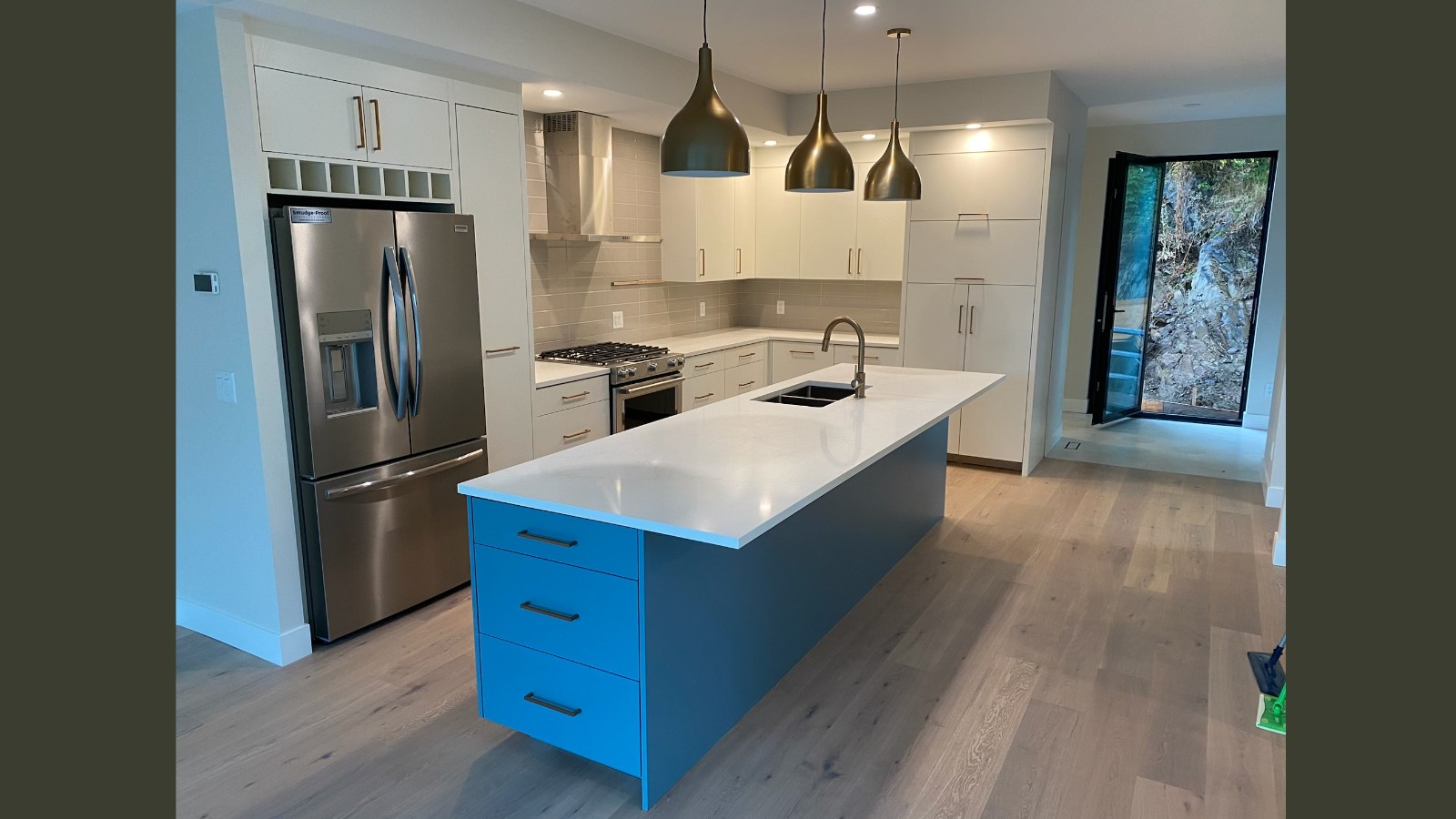
Should Your Kitchen Island be a Different Color? What We Tell Our Clients
Short answer: yes, if you actually like the look and you're not renovating purely to flip the house next spring. A contrast island is one of the lowest-risk ways to add personality to a kitchen without repainting every cabinet in the room — but it comes with a few trade-offs we think people should hear before they commit, not after the first coat is dry.
We get this question often, usually from someone who's been staring at Pinterest boards of navy or sage islands and wants to know if it'll look dated in five years, whether it's worth the extra cost, and what happens when the finish gets a ding from a dropped cast iron pan. Here's what we actually tell them.
Why a Contrast Island Works
A kitchen island sits apart from the perimeter cabinets both physically and visually — it's already the piece of furniture in the room that gets touched, leaned on, and looked at the most. Painting it a different color from the rest of your cabinetry leans into that instead of fighting it. In an open-concept kitchen, which describes most of the newer builds we see going up around Nelson, Rossland, and up the North Shore, a contrast island also does real work defining the kitchen zone without a wall or a soffit.
The other advantage is cost. If you're building new cabinets anyway, painting just the island a different color than the rest of the kitchen costs less than a full two-tone scheme on every upper and lower, and a lot less than redoing a whole kitchen in a bold color you might tire of. It's a way to test a color commitment on one piece of furniture instead of the whole room.
Where It Gets Risky
The design press has been going back and forth on this for a couple of years now — some writers are calling contrast islands over-trended and pushing people back toward all-one-color kitchens, others say it's still the easiest way to add personality to an otherwise neutral kitchen. Our take: the trend conversation matters less than how you pick the color and finish. The actual resale risk comes from two things, not the concept itself.
Bold, polarizing colors. A soft sage, navy, or warm charcoal reads as a design choice. A high-saturation teal or a trendy micro-trend color reads as this specific owner's choice, and that's what makes a buyer's agent nervous five years from now. If resale is any part of your thinking — and in a market like ours, where a lot of buyers are relocating and want a kitchen that doesn't need immediate work — stick to colors with some grey or black in the undertone rather than pure, bright hues.
Clashing undertones. This is the mistake we see most often on jobs we didn't build. Someone picks an island color in isolation, without testing it against the countertop, the wall paint, and the upper cabinet finish under the room's actual light. A blue-grey island can look great on a paint chip and flat or muddy next to a quartz counter with warm veining. We always tell clients to get a physical sample — not a chip, an actual painted sample board — and look at it in the kitchen at different times of day before we commit to it on the cabinet order. Kootenay light changes a lot between a west-facing kitchen in July and the same room under January cloud cover, and colors shift with it.
Durability: What Actually Holds Up
This is the part that gets skipped in most design articles, and it's the part that matters most for an island specifically, because an island takes more abuse than perimeter cabinets — it's where kids do homework, where guests set drinks during a dinner party, where someone inevitably drags a stand mixer across the top.
A few things we build into every painted island regardless of color:
- Cabinet-grade finish, not wall paint. We spray a catalyzed conversion varnish or a two-component urethane on painted cabinetry, never a wall-grade acrylic. Wall paint stays soft long after it feels dry to the touch, which means it scuffs, and on a door that closes against a frame, it can actually stick and peel over time.
- Real cure time. A painted door can feel dry within hours but isn't at full hardness for a couple of weeks. We tell clients to go easy on a brand-new painted island for the first few weeks — no rubber-footed mats, no leaning a tray of hot dishes right on the edge — while the finish fully cures.
- Substrate matters. A painted finish wants a smooth, stable substrate. MDF-core doors take paint better and show fewer grain-telegraphing issues over time than solid wood or plywood doors painted the same color — one of the few cases where MDF is the right call instead of a compromise. If you want the island painted and the rest of the kitchen in a wood grain, that's a normal combination for us to build.
- Keep the leftover paint, sealed and labelled. Dings happen. We send clients home with touch-up paint and the exact formula on file, because a scratch is a five-minute fix with the matching paint and a disaster without it.
Local Notes
A couple of things specific to this area:
- Finish needs to handle our humidity swings. A woodstove-heated house in February and a kitchen with the windows open in July put a painted finish through a wider humidity range than a climate-controlled coastal home. A properly sprayed catalyzed finish handles that; a brushed-on site finish is more likely to show hairline cracking at the joints over a few winters.
- Freight matters for custom paint colors. If you're matching a specific paint brand's color that we don't stock, factor in lead time for us to get the right tint base shipped in — Kootenay logistics add a few days to anything that has to come in off a highway delivery schedule, especially over a mountain pass in winter.
FAQ
Does a painted island cost more than a stained one? Usually a little, yes — paint-grade prep and a sprayed finish take more labour than a clear or stained finish on the same door style. But painting only the island instead of the whole kitchen keeps that cost increase small relative to the whole project.
Will a bold island color hurt my resale value? It can, if the color is highly saturated or trend-specific and the rest of the local market skews conservative. A muted, well-chosen color with good undertone matching is a much lower risk than a bright, of-the-moment shade.
Can I paint my existing island instead of replacing it? Sometimes — it depends on the door material and the condition of the existing finish. Melamine and laminate doors generally don't take paint well without specialty primers and are prone to chipping at the edges; solid wood and MDF doors are good candidates. We can take a look and tell you honestly whether it's worth doing versus building new doors.
How long before a new painted island is safe for normal use? It's touchable within a day, but we recommend treating it gently — no harsh cleaners, no dragging heavy pans across it — for about two to three weeks while the finish fully cures.
What if I want to change the color again in a few years? That's one of the advantages of painting only the island: repainting one piece of furniture down the line is a much smaller job than redoing an entire kitchen, and it's often doable without pulling the cabinets off the wall.
If you're weighing a painted island against a full cabinet refresh, our services page covers what we build in-house, and Reimagine is a good starting point if you want to see your own kitchen with a few color and layout options before you commit to anything. You can also look through our past kitchen projects for island color examples, or just get in touch and bring a photo of your kitchen in — that's usually faster than describing it over the phone.
Planning a project in the Kootenays?
Talk it through with a local shop — free consultation, honest advice, built-to-fit cabinetry from Nelson, BC.